VBTLX – Vanguard Total Bond Market Index Fund Providing Stable Income Through Diversified U.S. Bond Investments
Apr 20, 2026
VBTLX is a mutual fund offered by Vanguard that gives investors broad exposure to the entire U.S. investment-grade bond market in a single fund.
Instead of buying individual bonds, investors in VBTLX own a diversified mix of U.S. government bonds, corporate bonds, and mortgage-backed securities. It is commonly used as a stability and income component in long-term investment portfolios.
VBTLX tracks a broad U.S. bond index that includes thousands of bonds across different categories such as:
U.S. Treasury bonds
Government agency bonds
Investment-grade corporate bonds
Mortgage-backed securities
Asset-backed securities
According to fund data, it provides exposure to a wide range of U.S. investment-grade bonds across all maturities, making it highly diversified within fixed income markets (StockAnalysis).
VBTLX uses a passive index strategy, meaning it does not try to beat the bond market. Instead, it mirrors the performance of the overall U.S. bond market.
Key characteristics:
Broad diversification across bond types
Medium average duration (interest-rate sensitivity)
Monthly income through interest payments
Reinvestment options for compounding returns
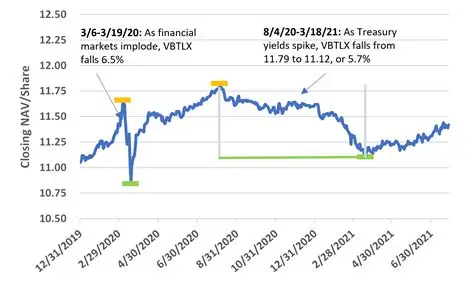
Because bond funds constantly trade underlying bonds, their value changes with interest rates and market conditions.
Investors typically include VBTLX in their portfolio for stability and balance.
Bonds tend to be less volatile than stocks.
The fund pays interest (yield) from bond holdings.
It reduces overall portfolio risk when combined with stocks.
Vanguard funds are known for very low expense ratios.
Bond prices may fluctuate, but long-term returns come from interest payments.
The fund holds a wide mix of bond types, including:
Backed by the U.S. government, considered very low risk.
Issued by large companies, offering higher yield but slightly more risk.
Bonds tied to housing loans.
High-quality bonds rated BBB or above.
This mix creates a balanced risk-return profile for fixed income investors.
| Feature | VBTLX | Stock Funds (like VTSAX/VFIAX) |
|---|---|---|
| Asset type | Bonds | Stocks |
| Risk level | Lower | Higher |
| Returns | Lower but steadier | Higher long-term potential |
| Volatility | Low to moderate | High |
| Role | Stability & income | Growth |
VBTLX is not meant for fast growth—it is meant to reduce risk and smooth portfolio performance.
Even though it is considered safer than stocks, it still has risks:
When interest rates rise, bond prices usually fall.
Inflation can reduce the real value of returns.
Corporate bonds carry risk if companies struggle financially.
Returns are modest and vary over time.
VBTLX is commonly used by:
Long-term investors building balanced portfolios
Retirement savers
Conservative investors
People near retirement needing stability
Investors using a “3-fund portfolio” strategy
It is especially popular as the bond portion of a diversified investment plan.
A common investing structure is:
U.S. Stocks → VTSAX / VFIAX
International Stocks → VTIAX
Bonds → VBTLX
This creates a globally diversified portfolio with growth + stability + income.
VBTLX is one of the simplest ways to invest in the entire U.S. bond market.
It does not aim for high growth—instead, it provides stability, diversification, and steady income that helps balance risk in a portfolio.
For long-term investors, VBTLX plays an important role as the “calm part” of an otherwise growth-focused investment strategy.