VBTLX – Vanguard Total Bond Market Index Fund Providing Stable Income Through Diversified U.S. Bond Investments
Apr 20, 2026
VBTLX is one of the most popular bond index funds for long-term investors seeking stability, income, and diversification. Managed by Vanguard, the fund provides broad exposure to the U.S. investment-grade bond market, including government bonds, corporate bonds, and mortgage-backed securities. (Vanguard)
VBTLX is commonly used in retirement portfolios and balanced investment strategies because bonds generally provide lower volatility than stocks.
VBTLX is a passive index mutual fund designed to track the Bloomberg U.S. Aggregate Float Adjusted Index, a benchmark representing the broad U.S. investment-grade bond market. (Vanguard)
The fund invests in:
U.S. Treasury bonds
Corporate bonds
Mortgage-backed securities
Asset-backed securities
It includes short-, intermediate-, and long-term bonds, creating a diversified fixed-income portfolio. (Vanguard)
Some major features of VBTLX include:
Broad bond market exposure
Passive index management
Low expense ratio
Monthly dividend distributions
Lower volatility than stock funds
The expense ratio is approximately 0.04%, making it one of the cheapest diversified bond funds available. (StockAnalysis)
Investors often use VBTLX to reduce portfolio risk and generate steady income.
Benefits include:
Bond funds usually fluctuate less than stock funds during market downturns.
VBTLX contains thousands of investment-grade bonds across different sectors. (StockAnalysis)
The fund pays regular monthly dividends from bond interest payments. (StockAnalysis)
Its low expense ratio helps investors keep more long-term returns.
| Feature | VBTLX | Stock Index Funds |
|---|---|---|
| Asset Type | Bonds | Stocks |
| Risk Level | Lower | Higher |
| Income Focus | Interest payments | Capital growth |
| Volatility | Moderate to low | Higher volatility |
| Long-Term Growth | Slower | Higher potential |
This is why many investors combine bond funds and stock funds together in diversified portfolios.
Many investors in online communities such as Reddit’s Bogleheads forum consider VBTLX a core “three-fund portfolio” holding. Some users describe it as a reliable diversification tool rather than a high-growth investment. (Reddit)
One Reddit user explained that investors sometimes misunderstand bond funds because total return includes both dividends and bond price movement, not just share price growth. (Reddit)
Although VBTLX is considered lower risk than stock funds, risks still exist:
Interest rate risk
Inflation risk
Bond price declines
Lower long-term growth potential
Economic uncertainty
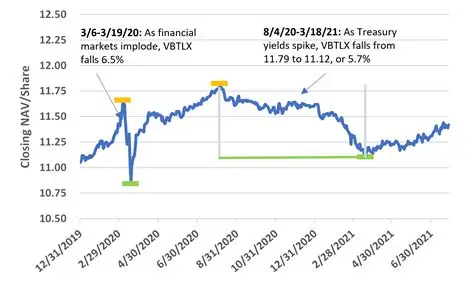
When interest rates rise, bond prices often fall. Long-duration bonds are especially sensitive to rate changes. (Reddit)
The ETF version of VBTLX is:
BND
Both investments track the same underlying bond index, but ETFs trade during market hours like stocks. (Kiplinger)
As of 2026, VBTLX has:
Expense ratio around 0.04%
SEC yield around 4.3%
Minimum investment of approximately $3,000 for Admiral Shares (Vanguard)
These low costs and diversified holdings are major reasons for the fund’s popularity among long-term investors.
The future performance of VBTLX depends heavily on:
Interest rate trends
Inflation levels
Federal Reserve policy
Economic growth
If interest rates decline, bond prices may rise. If rates increase further, bond funds could experience short-term pressure. Many investors still use diversified bond funds to balance risk in long-term portfolios. (Kiplinger)
VBTLX is one of the most widely used bond index funds for investors seeking diversification, stability, and income. By covering the entire U.S. investment-grade bond market at very low cost, the fund serves as a core holding in many retirement and long-term investment portfolios.
For investors building balanced portfolios, VBTLX can help reduce volatility while providing consistent fixed-income exposure.