VTSAX – Vanguard Total Stock Market Index Fund Covering the Entire U.S. Equity Market for Long-Term Growth
Apr 20, 2026
If you have ever spent time researching passive investing, the Bogleheads philosophy, or financial independence (FIRE), you have inevitably run into the ticker VTSAX.
Managed by Vanguard, the Vanguard Total Stock Market Index Fund Admiral Shares is the gold standard for hands-off, long-term equity investing. Rather than betting on a single sector or trying to pick individual winning stocks, VTSAX allows investors to buy a tiny piece of the entire investable United States stock market in one single transaction.
VTSAX is designed to track the performance of the CRSP US Total Market Index. The fund utilizes an indexing investment approach, meaning it automatically buys and holds stocks in proportion to their market capitalization.
Complete Diversification: The fund holds approximately 3,500 companies. It spans mega-cap tech giants down to small, micro-cap businesses.
The "Self-Cleaning" Nature: Because it is market-cap weighted, VTSAX dynamically adjusts. As massive companies grow, they naturally make up a larger percentage of the fund. If a company fails or shrinks, it automatically drops down the list or out of the fund entirely, without requiring active trading by a fund manager.
Vanguard is famous for pioneering low-cost investing, and VTSAX is a prime example of this philosophy.
Expense Ratio: 0.04%. This means for every $10,000 you invest, you pay just $4 a year in management fees. This is roughly 94% lower than the average expense ratio of competing mutual funds in the industry.
Minimum Initial Investment: $3,000 for Admiral Shares. (If you want to invest with less, you can buy its ETF equivalent, VTI, which has no minimum investment limit beyond the price of a single share).
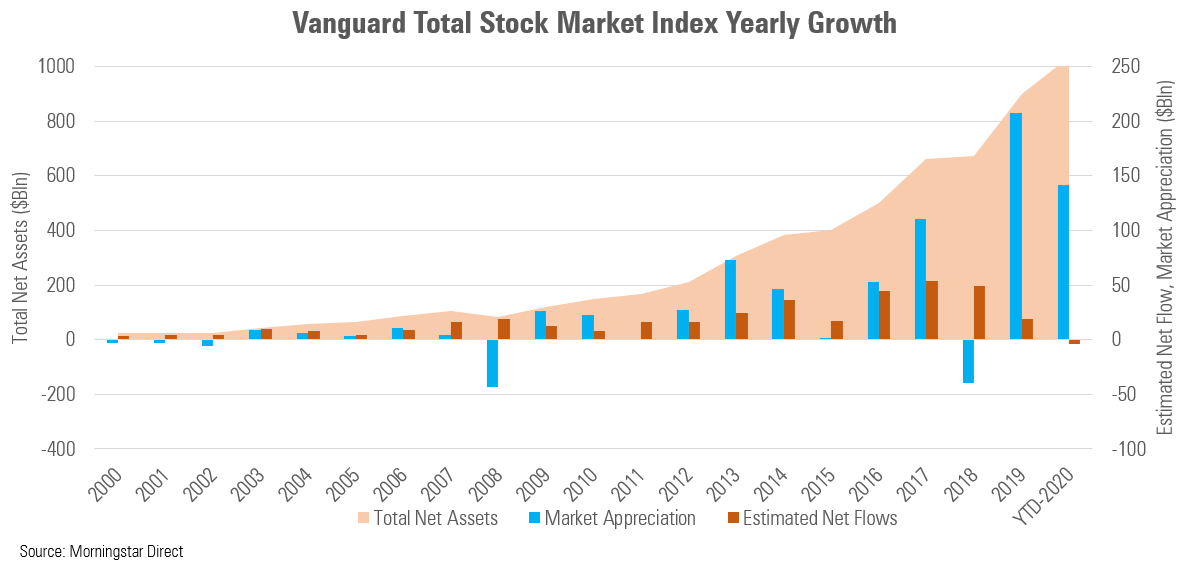
Total Net Assets: Over $1.4 Trillion (with the entire fund family, including ETFs, controlling over $2.2 Trillion), making it one of the largest pools of capital in existence.
Dividend Yield: Approximately 1.05%, distributed quarterly to shareholders.
While VTSAX contains small- and mid-cap companies, it is heavily weighted toward large-cap companies due to market capitalization rules.
| Sector | Approximate Exposure (% of Assets) |
|---|---|
| Information Technology | ~33.5% |
| Consumer Discretionary | ~13.4% |
| Financials | ~10.3% |
| Industrials | ~12.4% |
| Health Care | ~8.7% |
| Communication Services | ~9.5% |
NVIDIA Corp.
Apple Inc.
Microsoft Corp.
Amazon.com Inc.
Alphabet Inc. (Google)
The most common debate in index investing is choosing between VTSAX (Total Market) and VFIAX (Vanguard 500 Index Fund).
The Similarity: Because the largest 500 companies make up roughly 80% to 85% of the total market's value, VTSAX and VFIAX look and perform very similarly. Their top holdings are identical.
The Difference: VTSAX gives you exposure to roughly 3,000 additional small- and mid-cap companies that are completely absent from an S&P 500 fund. If small-cap companies go on a historic bull run, VTSAX will marginally outperform VFIAX.
Ultimate Simplification: You can build an entire retirement portfolio using VTSAX as your sole equity holding.
Rock-Bottom Fees: Fractional fees mean more of your money benefits from compounding interest over decades.
Tax Efficiency: Because it is a passive index fund with a very low turnover rate (~3%), it triggers minimal capital gains distributions, making it highly tax-efficient in brokerage accounts.
Tech-Heavy Concentration: Because it is market-cap weighted, a huge portion of your investment is tied up in the top handful of tech monopolies.
No International Exposure: VTSAX only holds U.S.-based corporations. To get global exposure, investors usually pair it with an international index fund like VTIAX.
VTSAX is not built for investors looking to "beat the market" or get rich overnight. It is engineered for patient wealth accumulation. By accepting the exact average return of the entire U.S. economy at a near-zero cost, investors who consistently add to VTSAX and automatically reinvest their quarterly dividends have historically captured one of the most reliable wealth-building engines ever created.