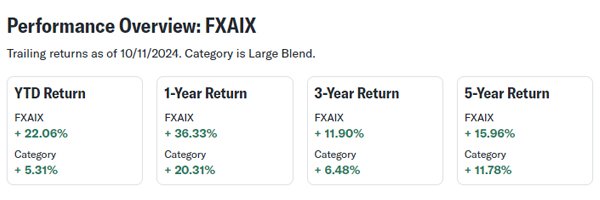
FXAIX – Fidelity 500 Index Fund Tracking the Performance of the S&P 500 for Long-Term Wealth Growth
Apr 20, 2026
When long-term investors talk about buying the S&P 500, Vanguard's flagship funds usually dominate the conversation. But over the last few years, Fidelity has quietly built an absolute powerhouse of a mutual fund that challenges Vanguard's crown: FXAIX.
FXAIX is the ticker symbol for the Fidelity 500 Index Fund. With over $790 billion in assets under management, it has become the default core position for millions of investors who call Fidelity home.
But what makes FXAIX so special, how does it compare to its famous Vanguard competitors, and is it the right choice for your investment portfolio? Let's break it down.
Suggested Image Alt Text (SEO): Fidelity FXAIX 500 index fund performance tracking the US stock market index
FXAIX is a passively managed index mutual fund that tracks the S&P 500 Index.
By investing in FXAIX, you are instantly buying a small stake in roughly 500 of the largest, most successful, and most stable publicly traded corporations in the United States. It handles all the heavy lifting for you—whenever companies inside the S&P 500 adjust in size, pay out dividends, or swap places, the fund automatically rebalances itself on the backend.
Because the S&P 500 is a market-capitalization-weighted index, the absolute largest mega-cap giants hold the keys to the fund's overall performance.
Information Technology: ~32.9%
Financials: ~12.5%
Communication Services: ~10.5%
Consumer Discretionary: ~10.0%
Health Care: ~9.5%
Because a few tech innovators command staggering valuations, the top ten assets make up over 38% of the entire portfolio:
NVIDIA Corp. (NVDA)
Apple Inc. (AAPL)
Microsoft Corp. (MSFT)
Amazon.com Inc. (AMZN)
Alphabet Inc. Class A (GOOGL)
Broadcom Inc. (AVGO)
Alphabet Inc. Class C (GOOG)
Meta Platforms Inc. Class A (META)
Tesla Inc. (TSLA)
Berkshire Hathaway Inc. Class B (BRK.B)
If you are trying to decide between Fidelity's premier fund and Vanguard’s twin S&P 500 options (VFIAX and VOO), under the hood, they track the exact same index and yield virtually identical long-term performance. However, FXAIX holds a few hidden structural advantages for retail investors:
| Feature | FXAIX (Fidelity Mutual Fund) | VFIAX (Vanguard Mutual Fund) | VOO (Vanguard ETF) |
|---|---|---|---|
| Expense Ratio | 0.015% (Cheapest) | 0.04% | 0.03% |
| Annual Fee per $10k | $1.50 | $4.00 | $3.00 |
| Initial Minimum | $0.00 (No minimum) | $3,000 | Price of 1 share |
| Trading Type | End of day (4:00 PM EST) | End of day (4:00 PM EST) | Intra-day like a stock |
| Fractional Reinvestment | Fully Automated | Fully Automated | Depends on Broker |
Suggested Image Alt Text: Chart showing how ultra low expense ratios save money over a 30 year investing timeline
While Vanguard is famous for low fees, Fidelity actually beats them here. FXAIX carries a jaw-droppingly low expense ratio of 0.015%. That means for every $10,000 you invest, Fidelity only charges you $1.50 a year to manage your money. This allows almost 100% of the market's compounding returns to stay directly in your pocket.
Unlike Vanguard's S&P 500 mutual fund (VFIAX), which demands a steep $3,000 initial minimum to get started, FXAIX has a $0 minimum requirement. You can open an account today and start investing with as little as a single dollar.
Because FXAIX is a traditional mutual fund, it is built perfectly for the hands-off, set-it-and-forget-it investor. You can easily instruct your brokerage account to automatically pull a set amount of cash from your checking account every payday and instantly purchase fractional shares of FXAIX.
While FXAIX is a flawless index fund, there is one critical rule to keep in mind: Only buy FXAIX if you use Fidelity as your primary brokerage platform. If you try to buy FXAIX inside a Vanguard or Charles Schwab account, those competing platforms will often slap you with a heavy transaction fee (sometimes up to $50 per trade) to buy a rival company's mutual fund. If you are outside the Fidelity ecosystem, sticking to an S&P 500 ETF like VOO or IVV is a much more tax-efficient and friction-free move.
FXAIX represents the absolute peak of modern, low-cost indexing. By combining a microscopic 0.015% fee structure with zero investment minimums and automated compounding mechanics, it gives everyday investors a perfect foundation to systematically build long-term financial independence.